Candle care
Everything we know
about burning one.
Roughly forty hours are sitting in that jar. These are the habits that get you all of them.
1/4"6 mm
Wick, before every burn
2-4hours
One sitting, start to snuff
1/2"13 mm
Wax left when you retire it
40hours
What one jar gives you
Start here
The first burn sets the shape of every burn after it.
Soy melts outward from the wick, and the first burn is the one that decides how wide that pool is allowed to get. Cut it short and the candle keeps following the narrow path you gave it, digging a shaft down the middle and leaving a wall of wax welded to the glass.
So the first time, light it when you have a couple of hours and let it run until the melted pool reaches the edge of the jar. In an 8 oz jar that is usually two to three hours. A thin rim of firm wax right at the wall is fine. A thick ring is the thing you are avoiding.
If you only have twenty minutes, wait. It is the one burn worth saving for later.
Already have a ring? You can usually get it back. Wrap the top of the jar loosely in foil, leave a gap over the flame, and burn it for an hour or two. The trapped heat melts the wall back down level. Stay in the room while the foil is on, and take it off before you walk away.
Pool reaches the glass
The candle burns flat and level all the way down.
Pool stops short
Every burn after this one follows the same narrow track.
After that, it is four habits.
None of them take longer than the time it takes to find a match.
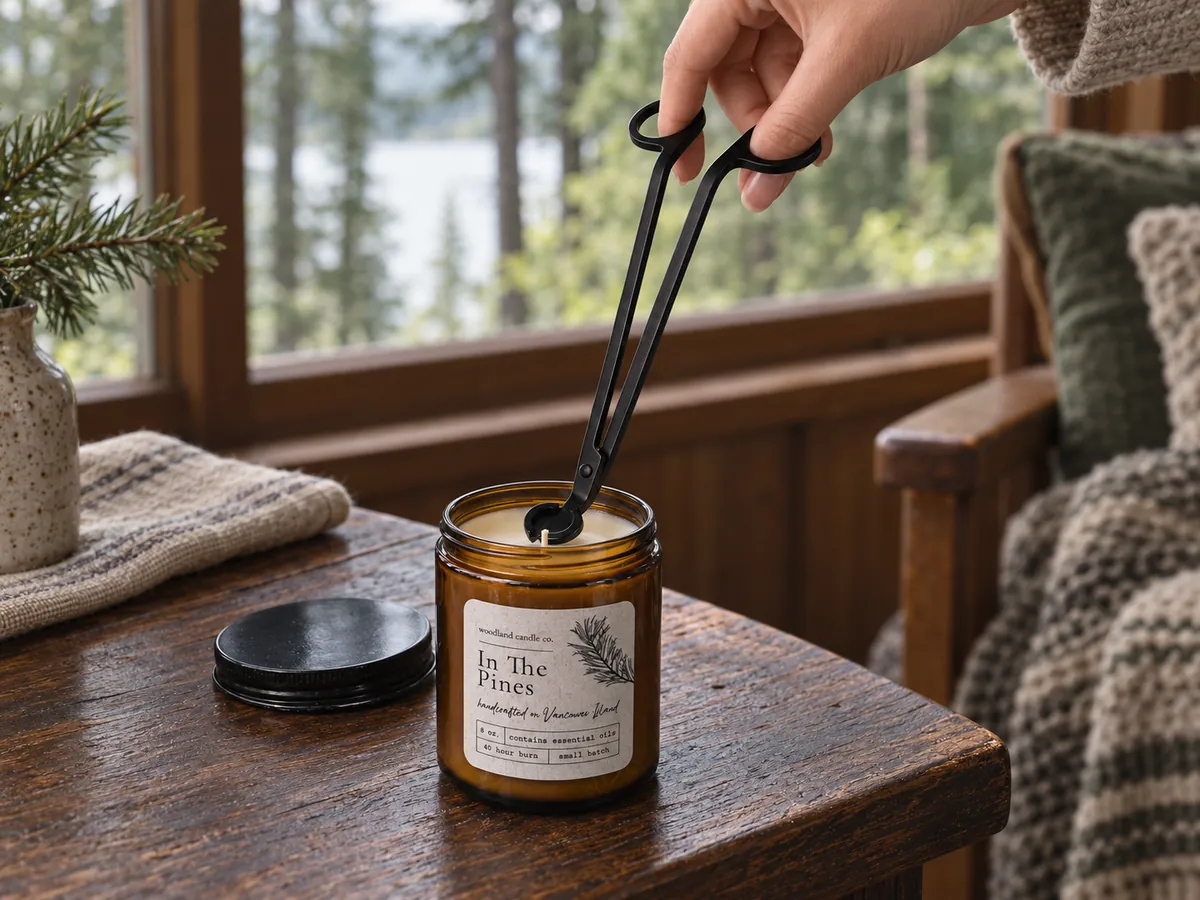
Trim to a quarter inch.
Every time, on a cold candle, before you light it. A long wick makes a tall restless flame, and a restless flame is what puts soot on the glass. Nail scissors are fine. So are your fingers on a cooled wick, as long as you fish the black bits out of the wax before you light it again.
Two to four hours, then stop.
Two hours is enough for a full pool and the scent that comes with it. Past four, the jar is holding more heat than it needs, the wick starts to lean and mushroom, and the wax burns off faster than the fragrance can keep up. Let it cool right down before the next light.
Put it out without the smoke.
A snuffer is cleanest. Free and just as good: bend the wick into the melted wax with a toothpick, then lift it straight again. It goes out instantly, there is no smoke trail, and the wick comes back coated in wax so the next light is easy. Blowing works, it just sends a plume of soot into the room. Never smother it with the lid, and never use water.
Lid on once it is cold.
The lid keeps dust out of the pool and slows the scent evaporating between burns. Put it on warm and you seal in moisture and soot instead. Wait for the wax to set hard, then close it and keep the jar somewhere cool and out of direct sun. Sunlight fades fragrance faster than burning does.
Getting the scent to fill a room.
The oils go into the wax while it is still molten, which is why a Woodland jar smells like something before you have even lit it. What you are smelling then is only half of what the candle has to give.
Three things move the hot throw more than people expect. Give it a full pool, because the pool is the surface doing the work. Shut the door, because one 8 oz candle is built for a bedroom or an office rather than an open floor. And if you bought it off the table at a market, give it a week in the cupboard first. Soy keeps settling and binding with the oil for days after it is poured, and a rested candle throws noticeably harder than a fresh one.
- Cold throw
- What you smell with the lid off and the wick unlit. It comes off the surface of the wax alone, so it is always the quieter of the two.
- Hot throw
- What you smell once there is a pool of melted wax. Heat releases layers the cold jar never shows, which is why a candle can smell different burning than it does in your hand.
Things that look like faults and are not.
Natural wax moves. A candle poured from 100% soy will do all three of these at some point, and a candle that never does has something in it holding the wax still.
Frosting
A white crystalline bloom on the surface or creeping up the inside of the glass. Soy is polymorphic, so it keeps rearranging into more stable crystal forms long after it is poured, and a swing in room temperature speeds that up. It is the mark of unblended natural wax. It changes nothing about the burn or the scent.
Wet spots
Patches where the wax has let go of the glass and left a shadow behind. Wax shrinks as it cools and glass does not, so somewhere along the wall the two part company. Cosmetic, permanent, and completely harmless.
An uneven top
Soy sets from the outside in and can pull a small dip or a rough patch in around the wick as it hardens. The first full melt pool levels the surface out, and once it has, it stays level.
If something looks off.
- The flame is tall and dancing.
- The wick is too long, or the candle is sitting in moving air. Put it out, let it cool, trim to a quarter inch, and move it away from the window, the fan, or the heating vent.
- Soot is climbing the inside of the glass.
- Same two causes, and it is worth fixing rather than living with: a steady flame on a trimmed wick barely soots at all. Wipe the glass with a dry paper towel once the candle is cold.
- A small dark ball has formed on the wick.
- Carbon, and it means the wick was due a trim. Ours is cotton braided around a paper filament, which curls the tip into the hottest edge of the flame and mostly burns itself clean, so it should be rare. Trim it off cold.
- There is a ring of hard wax around the edge.
- A short burn somewhere in its history. The foil trick above will melt it back level in an hour or two.
- The scent has gone quiet.
- Your nose adapts to a smell within minutes of sitting in it, and that is usually all this is. Leave the room, come back, and judge it then. If it really is faint, check that you are getting a full pool and that the door is shut.
- There are beads of oil on the surface.
- The jar has been stored somewhere warm and the fragrance has sweated out of the wax. It burns off harmlessly on the next light. Keep it somewhere cooler.
- The jar is hot to the touch.
- Normal in the last hour of a long burn, and the reason it belongs on something heatproof. Hot with plenty of wax still in it means the sitting is running too long.
Safety
The seven that actually matter.
An open flame in a glass jar. Most of this is obvious and all of it is worth reading once.
- Never leave a burning candle alone in a room, and never fall asleep with one lit.
- Stable heatproof surface, and at least 12 inches (30 cm) from curtains, bedding, paper, and anything else that catches.
- Burning more than one? Leave 3 inches (7.5 cm) between them so they do not melt each other.
- Out of reach of children and pets, and clear of anywhere a tail or a sleeve swings past.
- Never move the jar while the wax is liquid or the glass is still warm.
- Retire it at about half an inch of wax. Burning a container dry puts the flame against the base and the glass takes heat it was never built for.
- Air the room. Any open flame puts fine particulate into the air, soy included, and a trimmed wick out of a draft produces a small fraction of what a tall flickering one does. Crack a window if anyone in the house has asthma. Birds are extremely sensitive to airborne compounds, so keep candles out of any room a bird lives in, and ask your vet before burning scented candles around a cat with breathing trouble.
The last half inch, and the jar after it.
When the wax runs low, stop burning it. There is more use left in the glass than there is in the last centimetre of wax, and two ways to get one from the other.
The freezer. Leave the jar in overnight. Wax shrinks as it gets cold and the plug usually lifts out in one piece with a push from the back of a spoon. Lever the little metal wick tab off while you are there.
Hot water. Fill the jar with just-boiled water and leave it alone. The wax floats up and sets into a disc on top as it cools, and the disc lifts straight out.
Either way the wax goes in the bin, never down the drain. It does not dissolve, and it sets hard in the trap. Finish with warm water and dish soap to cut the last of the oil. The glass is dishwasher safe once the wax is out. Wash the lid by hand so the matte black stays matte.
What you are left with is an 8 oz amber jar and a lid that seals. Brushes, cotton buds, spices, screws, a cutting from the garden, a tealight on a windowsill.
Time for the next one.
Five scents, all hand-poured on Vancouver Island, all collected in the Comox Valley.